The public-facing FabricLoader instance. More...
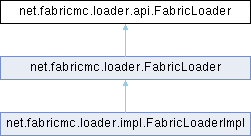
Public Member Functions | |
| < T > List< T > | getEntrypoints (String key, Class< T > type) |
Returns all entrypoints declared under a key, assuming they are of a specific type. | |
| < T > List< EntrypointContainer< T > > | getEntrypointContainers (String key, Class< T > type) |
Returns all entrypoints declared under a key, assuming they are of a specific type. | |
| < T > void | invokeEntrypoints (String key, Class< T > type, Consumer<? super T > invoker) |
Invokes an action on all entrypoints that would be returned by getEntrypointContainers(String, Class) for the given key and type. | |
| ObjectShare | getObjectShare () |
| Get the object share for inter-mod communication. | |
| MappingResolver | getMappingResolver () |
| Get the current mapping resolver. | |
| Optional< ModContainer > | getModContainer (String id) |
| Gets the container for a given mod. | |
| Optional< ModContainer > | quilt_getModContainer (Class<?> clazz) |
Provided to make it easier to call QuiltLoader#getModContainer(Class) via reflection for fabric-only mods. | |
| Collection< ModContainer > | getAllMods () |
| Gets all mod containers. | |
| boolean | isModLoaded (String id) |
| Checks if a mod with a given ID is loaded. | |
| boolean | isDevelopmentEnvironment () |
| Checks if Fabric Loader is currently running in a "development" environment. | |
| EnvType | getEnvironmentType () |
| Get the current environment type. | |
| String | getRawGameVersion () |
| Get the original unprocessed game version. | |
| Object | getGameInstance () |
| Get the current game instance. | |
| Path | getGameDir () |
| Get the current game working directory. | |
| File | getGameDirectory () |
| Path | getConfigDir () |
| Get the current directory for game configuration files. | |
| File | getConfigDirectory () |
| String[] | getLaunchArguments (boolean sanitize) |
| Gets the command line arguments used to launch the game. | |
Static Public Member Functions | |
| static FabricLoader | getInstance () |
| Returns the public-facing Fabric Loader instance. | |
Detailed Description
The public-facing FabricLoader instance.
To obtain a working instance, call getInstance().
- Since
- 0.4.0
- Deprecated
- Please migrate to using
QuiltLoaderdirectly instead - except forgetEnvironmentType(), which is now located inMinecraftQuiltLoader.
Member Function Documentation
◆ getAllMods()
| Collection< ModContainer > net.fabricmc.loader.api.FabricLoader.getAllMods | ( | ) |
Gets all mod containers.
- Returns
- a collection of all loaded mod containers
Implemented in net.fabricmc.loader.impl.FabricLoaderImpl.
◆ getConfigDir()
| Path net.fabricmc.loader.api.FabricLoader.getConfigDir | ( | ) |
Get the current directory for game configuration files.
- Returns
- the configuration directory
Implemented in net.fabricmc.loader.impl.FabricLoaderImpl.
◆ getEntrypointContainers()
| < T > List< EntrypointContainer< T > > net.fabricmc.loader.api.FabricLoader.getEntrypointContainers | ( | String | key, |
| Class< T > | type ) |
Returns all entrypoints declared under a key, assuming they are of a specific type.
The entrypoint is declared in the fabric.mod.json as following:
  "entrypoints": {
    "<a key>": [
      <a list of entrypoint declarations>
    ]
  }
Multiple keys can be present in the entrypoints section.
An entrypoint declaration indicates that an arbitrary notation is sent to a LanguageAdapter to offer an instance of entrypoint. It is either a string, or an object. An object declaration is of this form:
  {
    "adapter": "<a custom adatper>"
    "value": "<an arbitrary notation>"
  }
A string declaration <an arbitrary notation> is equivalent to
  {
    "adapter": "default"
    "value": "<an arbitrary notation>"
  }
where the default adapter is the adapter offered by Fabric Loader.
- Parameters
-
key the key in entrypoint declaration in fabric.mod.jsontype the type of entrypoints <T> the type of entrypoints
- Returns
- the entrypoint containers related to this key
- Exceptions
-
EntrypointException if a problem arises during entrypoint creation
- See also
- LanguageAdapter
◆ getEntrypoints()
| < T > List< T > net.fabricmc.loader.api.FabricLoader.getEntrypoints | ( | String | key, |
| Class< T > | type ) |
Returns all entrypoints declared under a key, assuming they are of a specific type.
- Parameters
-
key the key in entrypoint declaration in fabric.mod.jsontype the type of entrypoints <T> the type of entrypoints
- Returns
- the obtained entrypoints
- See also
- #getEntrypointContainers(String, Class)
Implemented in net.fabricmc.loader.FabricLoader.
◆ getEnvironmentType()
| EnvType net.fabricmc.loader.api.FabricLoader.getEnvironmentType | ( | ) |
Get the current environment type.
- Returns
- the current environment type
Implemented in net.fabricmc.loader.impl.FabricLoaderImpl.
◆ getGameDir()
| Path net.fabricmc.loader.api.FabricLoader.getGameDir | ( | ) |
Get the current game working directory.
- Returns
- the working directory
Implemented in net.fabricmc.loader.impl.FabricLoaderImpl.
◆ getGameInstance()
| Object net.fabricmc.loader.api.FabricLoader.getGameInstance | ( | ) |
Get the current game instance.
Can represent a game client or server object. As such, the exact return is dependent on the current environment type.
The game instance may not always be available depending on the game version and environment.
- Returns
- A client or server instance object
- Deprecated
- This method is experimental and its use is discouraged.
Implemented in net.fabricmc.loader.impl.FabricLoaderImpl.
◆ getLaunchArguments()
| String[] net.fabricmc.loader.api.FabricLoader.getLaunchArguments | ( | boolean | sanitize | ) |
Gets the command line arguments used to launch the game.
The implementation will try to strip or obscure sensitive data like authentication tokens if sanitize is set to true. Callers are highly encouraged to enable sanitization as compromising the information can easily happen with logging, exceptions, serialization or other causes.
There is no guarantee that sanitize covers everything, so the launch arguments should still not be logged or otherwise exposed routinely even if the parameter is set to true. In particular it won't necessarily strip all information that can be used to identify the user.
- Parameters
-
sanitize Whether to try to remove or obscure sensitive information
- Returns
- the launch arguments for the game
Implemented in net.fabricmc.loader.impl.FabricLoaderImpl.
◆ getMappingResolver()
| MappingResolver net.fabricmc.loader.api.FabricLoader.getMappingResolver | ( | ) |
Get the current mapping resolver.
When performing reflection, a mod should always query the mapping resolver for the remapped names of members than relying on other heuristics.
- Returns
- the current mapping resolver instance
- Since
- 0.4.1
Implemented in net.fabricmc.loader.impl.FabricLoaderImpl.
◆ getModContainer()
| Optional< ModContainer > net.fabricmc.loader.api.FabricLoader.getModContainer | ( | String | id | ) |
Gets the container for a given mod.
- Parameters
-
id the ID of the mod
- Returns
- the mod container, if present
Implemented in net.fabricmc.loader.impl.FabricLoaderImpl.
◆ getObjectShare()
| ObjectShare net.fabricmc.loader.api.FabricLoader.getObjectShare | ( | ) |
Get the object share for inter-mod communication.
The share allows mods to exchange data without directly referencing each other. This makes simple interaction easier by eliminating any compile- or run-time dependencies if the shared value type is independent of the mod (only Java/game/Fabric types like collections, primitives, String, Consumer, Function, ...).
Active interaction is possible as well since the shared values can be arbitrary Java objects. For example exposing a Runnable or Function allows the "API" user to directly invoke some program logic.
It is required to prefix the share key with the mod id like mymod:someProperty. Mods should not modify entries by other mods. The share is thread safe.
- Returns
- the global object share instance
- Since
- 0.12.0
Implemented in net.fabricmc.loader.impl.FabricLoaderImpl.
◆ getRawGameVersion()
| String net.fabricmc.loader.api.FabricLoader.getRawGameVersion | ( | ) |
Get the original unprocessed game version.
There is normally a Semver-compatible derived game version, obtainable from a mod container representing the game, that is derived from this raw version. The raw version may not comparable or even follow a well defined pattern, making it unusable for dependency range evaluation.
Implemented in net.fabricmc.loader.impl.FabricLoaderImpl.
◆ invokeEntrypoints()
| < T > void net.fabricmc.loader.api.FabricLoader.invokeEntrypoints | ( | String | key, |
| Class< T > | type, | ||
| Consumer<? super T > | invoker ) |
Invokes an action on all entrypoints that would be returned by getEntrypointContainers(String, Class) for the given key and type.
The action is invoked by applying the given invoker to each entrypoint instance.
Exceptions thrown by invoker will be collected and thrown after all entrypoints have been invoked.
- Parameters
-
key the key in entrypoint declaration in fabric.mod.jsontype the type of entrypoints invoker applied to each entrypoint to invoke the desired action <T> the type of entrypoints
- See also
- #getEntrypointContainers(String, Class)
◆ isDevelopmentEnvironment()
| boolean net.fabricmc.loader.api.FabricLoader.isDevelopmentEnvironment | ( | ) |
Checks if Fabric Loader is currently running in a "development" environment.
Can be used for enabling debug mode or additional checks.
This should not be used to make assumptions on certain features, such as mappings, but as a toggle for certain functionalities.
- Returns
- whether or not Loader is currently in a "development" environment
Implemented in net.fabricmc.loader.impl.FabricLoaderImpl.
◆ isModLoaded()
| boolean net.fabricmc.loader.api.FabricLoader.isModLoaded | ( | String | id | ) |
Checks if a mod with a given ID is loaded.
- Parameters
-
id the ID of the mod, as defined in fabric.mod.json
- Returns
- whether or not the mod is present in this Fabric Loader instance
Implemented in net.fabricmc.loader.impl.FabricLoaderImpl.
◆ quilt_getModContainer()
| Optional< ModContainer > net.fabricmc.loader.api.FabricLoader.quilt_getModContainer | ( | Class<?> | clazz | ) |
Provided to make it easier to call QuiltLoader#getModContainer(Class) via reflection for fabric-only mods.
Implemented in net.fabricmc.loader.impl.FabricLoaderImpl.
The documentation for this interface was generated from the following file:
- src/fabric/api/java/net/fabricmc/loader/api/FabricLoader.java